
Culture Factory Korjaamo
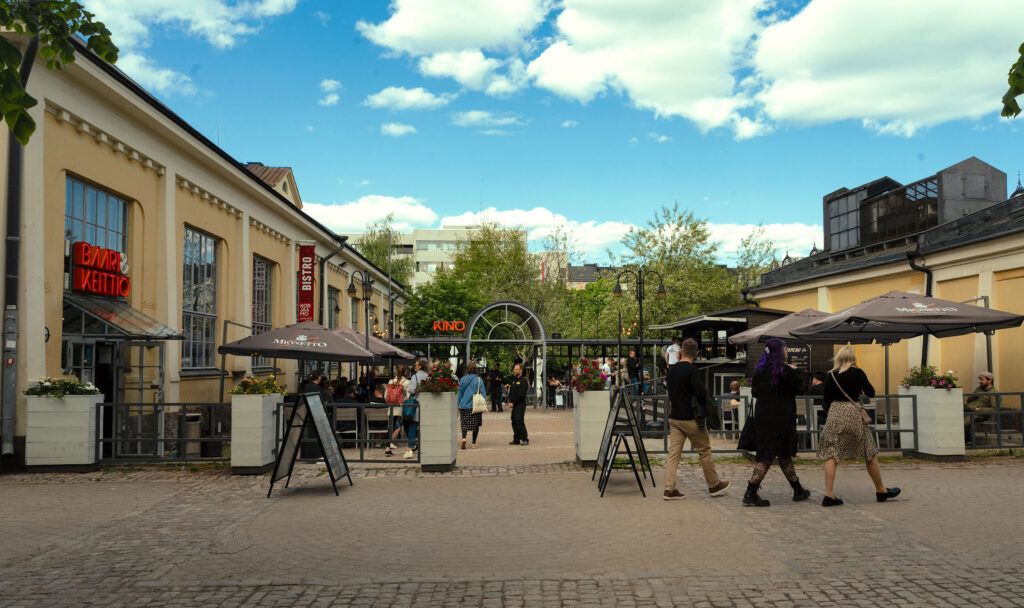
Located in Helsinki’s Töölö district, in historic tram depot halls, Culture Factory Korjaamo is one of the largest independent culture and event venues in the Nordic countries.

Versatile spaces and wide-ranging services
The historic setting conceals adaptable event spaces. The unique Vaunusali offers a setting for seminars of up to 300 people, in Kulmasali you can hold a gig for 220 people, or how about a dinner for 60 in the atmospheric Vintti. Rounding out the offering is the 120-seat Kino Töölö, which adapts excellently to private film screenings, gigs and seminars alike. In the immediate vicinity of Kulmasali and Kino Töölö, in Korjaamohalli, you can hold a cocktail event for up to 200 people.
Korjaamo is more than just a venue — we are your comprehensive partner. We produce a significant amount of our own creative content, while also offering first-class facilities, strong technical expertise, and a menu built from the best seasonal ingredients for both our lunch guests and our catering clients.

Flavor experiences and an urban summer oasis
Korjaamo’s beating heart is Korjaamo Bar & Bistro, offering high-quality street food and a diverse drinks selection in a relaxed setting. In summer, our operations expand to their full glory, as our courtyard terrace, completely unique in the city center, seating 400 and equipped with a fixed stage comes alive as a lush oasis.
Culture Factory Korjaamo is a place where creativity, business and experiences meet seamlessly.
We are guided by values that make us a unique meeting place and a responsible operator
At the core of Korjaamo are respect, openness and uncompromising professionalism, which form the foundation for everything we do.
We are committed to comprehensive responsibility:
- Ecological sustainability: We minimize our negative impact on the environment through our choices.
- Economic continuity: We create stability that enables long-term development of our operations, provides jobs, and generates added value for our owners.
- Social sustainability: We build a safe and equal place for ourselves as well as for our customers.
- Cultural diversity: We promote a rich and multi-voiced urban culture.
Our goal is to be the best workplace in the event industry, where every employee and guest feels seen and heard.
We are committed to conserving natural resources and increasing our positive impact on the environment. For us, environmental responsibility means concrete actions in our own operations. As proof of this, Korjaamo was awarded the Ekokompassi (Eco-Compass) certificate in spring 2025.
History of the tram depot halls and Korjaamo
1888

The Helsinki Tramway and Omnibus Company was founded in 1888, when traffic began on the first horse-drawn tram line between Töölö and Kaivopuisto. The company leased a plot for stables from the northern part of the Rosavilla villa area.
Before the era of electric trams, in the late 1800s, the Ruusula villa area had horse stables with tram horses, as well as a carriage shed, laundry house, oil storage, and saddlery workshop.
1900
The tram depot with arched windows on the corner of Töölönkatu and Eino Leinonkatu was completed in 1900, designed by architect Waldemar Aspelin. The tram depot was built on the Ruusula site used by the Helsinki Tramway and Omnibus Company, as a result of electricity powered tram traffic. The building originally had doors at both ends, so trams could be driven straight through it. In addition, while horse-drawn trams were in use, the building housed a horseshoeing forge.
The building’s detailing is concentrated on the ends and the curved roof lanterns. The long facades are timber-framed but plastered. Electricity replaced horses in 1901. Around the same time, a new construction phase began at the depot.
1909
A single-story repair hall (korjaamohalli), designed by master builder Richard Willman, was completed in 1909 on the corner of Töölönkatu and Humalistonkatu.
1911
Later, a larger tram hall was built next door — today’s Töölö tram depot. The most notable contribution to the depot area’s design was made by architect Selim A. Lindqvist. In the complex of three large arched halls designed in 1911, Lindqvist and structural designer Jalmar Gastrin drew on experience gained from developing the reinforced concrete structures of the Suvilahti power plant. Narrow pillars support the roof of the spacious halls. The building complex was completed in 1927 with an office building (Humalistonkatu 4) designed by Lindqvist, which today serves as a service home. The residential building known as the “Sipoo Church,” designed by Aspelin and used as housing for the company’s employees, was demolished to make way for the residential and commercial building completed in 1979 on the corner of Mannerheimintie and Humalistonkatu.
1992
In 1992, the tram hall was converted into the tram museum according to plans by architect Bengt Lundsten.
1993
The converted tram hall, now museum, opened to the public in 1993.
2004
Korjaamo opened to customers during spring 2004. The first public event was on 27 March 2004.
Raoul Grünstein brought with him, four magazines published by Image Kustannus – Image, Mondo, Muoto and Viini. They moved into the tram halls, along with the sponsorship-specialized consulting firm Image Match. Image Funk also operated in the space. The first exhibition, A K Dolven’s video installation 2:57, opened to the public on 27 March 2004. “The Korjaamo Talk” discussion evenings, produced in cooperation with Radio Helsinki, began on 22 April 2004. The bar and terrace opened in May.
2006
Korjaamo developed into a cultural center during 2006, when it agreed on cooperation with the Helsinki City Museum and the Cultural Office. The operations of the Tram Museum, owned by the City Museum, and Cultural Center Korjaamo were combined.
2015
Korjaamo Galleria, which had operated alongside Korjaamo for over 10 years, ceased operations.
2016
Korjaamo Kino opened its doors.
2020
In the middle of the coronavirus pandemic in 2020, Korjaamo got new owners: alongside Livson Group, Jaajo Linnonmaa, Antti Luusuaniemi, Wille Niinistö and Kim Heiniö became owners of Korjaamo. The new owners’ aim is to continue developing Korjaamo, in all its functions, into the city’s most interesting meeting place, with exceptionally high-quality services, for city residents, cultural operators and corporate clients.
2026
Korjaamo Kino was renovated and rebranded as Kino Töölö.
Sources include:
https://kaupunginosat.fi/toolo/wp-content/uploads/sites/23/2016/02/Kotisivut_Taka-Toolon_arkkitehtuuriopas.pdf
https://www.raitio.org/suomen-raitiotiet-ja-raitiovaunut/helsingin-raitiotiet/rataverkko/historiaa/
https://www.kaleva.fi/helsingin-tooloon-ensi-vuonna-uusi-kulttuurikeskus/2048343